
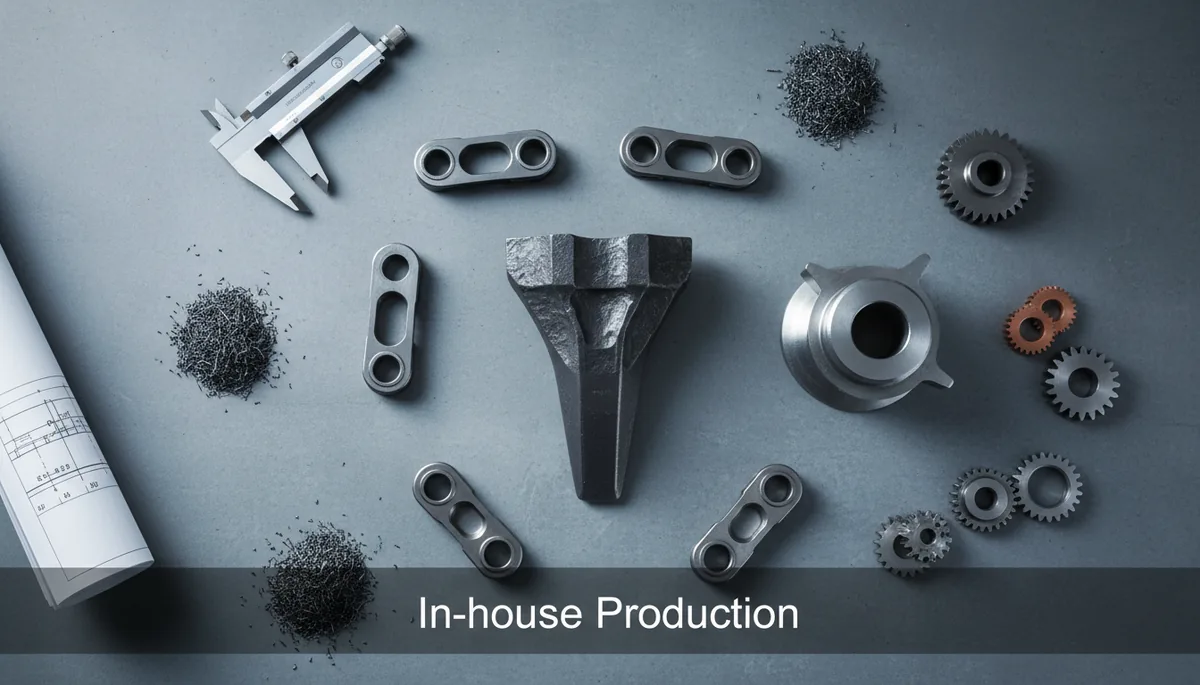
Leveraging SongWang’s In-House Equipment for Strong Production Capacity and Shorter Lead Times
For procurement, maintenance, and operations managers in construction, mining, and heavy-equipment fleets, reliable spare parts and predictable delivery matter as much as product performance. SongWang’s integrated, in-house production—covering forging, machining, heat treatment, and assembly—delivers higher throughput, shorter lead times, and a one-stop sourcing option for critical excavator and bulldozer components. ⏱️ 7-min read
In-house equipment and production capacity
Controlling the core production stages internally gives SongWang a clear advantage when demand fluctuates. By keeping forging presses, CNC machining centers, heat-treatment ovens, and assembly lines under one roof, the company can align capacity with incoming orders rather than relying on a chain of external vendors. That alignment reduces the typical bottlenecks caused by cross-supplier scheduling, shipping delays, and mismatched capacity windows.
Practically, this integrated setup translates into faster response at peak times. When a customer needs replacement bucket teeth or a short run of track chain links to keep a site operational, SongWang can re-prioritize production sequences, redeploy shifts, or run overtime on specific cells to meet urgent requirements. This flexibility shortens internal lead times and reduces lost production days for the customer.
End-to-end control also minimizes handoffs that commonly add days or weeks to delivery. Raw material receipt, forgings, machining, heat treatment, and final assembly occur in a coordinated workflow, with digital scheduling and shop-floor feedback closing the loop. For buyers, that means fewer surprises in project planning and a consistent cadence of deliveries aligned to maintenance windows or production ramps.
Core products and manufacturing strengths
SongWang focuses on wear-critical parts where performance and fit are non-negotiable: forged bucket teeth, track chains, and bogie guides for excavators and bulldozers. These components are designed for durability—optimized geometries concentrate hardness where it’s needed and reduce stress risers that lead to premature failure. Forging provides the grain flow and toughness big machines require, while precision machining ensures repeatable fitment across serial production.
Customization is another strength. Whether customers need alternative tooth profiles for abrasive rock, thicker wear edges for recycling applications, or modified bogie guides for a specific undercarriage configuration, SongWang adapts tooling and machining programs to deliver. The company routinely converts customer drawings, OEM part numbers, or on-site samples into production-ready CAD/CAM programs, enabling accurate, cross-compatible replacements.
Examples of practical adaptations include hard-facing recipes for extreme abrasion, stepped tooth geometries for improved penetration, or modified chain link bush sizes to match older undercarriage systems. These tailored approaches allow operators to extend component life where it matters and avoid the downtime and costs associated with repeated replacements.
Quality management you can rely on
Quality assurance is embedded across the workflow—from material sourcing to the final inspection stage. SongWang maintains traceability on incoming steel batches and applies documented heat-treatment cycles to achieve target microstructures and surface hardness. Process controls, including calibrated gauges, hardness testers, and thermal profiling, ensure each lot meets the specified mechanical properties before assembly.
Dimensional verification and nondestructive checks further reduce failure risk. Finished parts undergo coordinate measuring, hardness mapping, and visual inspection; critical components may receive ultrasonic or magnetic-particle inspection as needed. This layered QA approach prevents out-of-spec batches from reaching the field and lowers unexpected downtime for end-users.
Traceable QA documentation—material certificates, heat-treatment records, and inspection reports—gives procurement teams the paperwork they need for audits or OEM approvals. In short, consistent quality reduces service calls, improves mean time between failures (MTBF), and provides the confidence required by high-utilization assets in mining and construction.
One-stop sourcing and customization
Consolidating multiple part categories with a single supplier simplifies procurement and logistics. Buyers can source bucket teeth, chain assemblies, bogie guides, and ancillary wear parts through one purchasing channel, reducing purchase order overhead, freight consolidation costs, and the administrative burden of managing several vendors. For multi-site fleets, this streamlining translates into fewer suppliers to vet and a single point of contact for expedited needs.
SongWang offers low minimum order quantities (MOQs) and rapid prototyping to accelerate adoption of custom designs. Small-batch runs allow maintenance teams to trial modified geometries or upgraded alloys in the field before committing to larger inventories. Rapid prototyping—often completed within business weeks depending on complexity—helps teams validate fit, performance, and installation procedures with minimal lead time.
The combined sourcing and customization model supports a pragmatic spare-parts strategy: keep critical spares on hand while leveraging quick-turn production for seasonal or project-based demand. This hybrid approach lowers inventory carrying costs without sacrificing the ability to respond to unplanned repairs.
Pricing and efficiency advantages
Manufacturing more steps in-house reduces dependency on intermediaries and the markup that comes with them. By internalizing forging, machining, and assembly, SongWang captures value along the chain and can pass cost efficiencies to customers. This structure supports more stable pricing, especially when material markets fluctuate—buyers face fewer surprise increases tied to multiple vendor contracts.
Operational efficiency also improves planning. Reliable on-time delivery and predictable production windows let operations managers schedule maintenance during planned downtime rather than hold excessive safety stocks. That reduces capital tied up in inventory and minimizes storage costs at remote sites or depots.
For procurement teams, the combined benefits—competitive pricing, consolidated logistics, and consistent delivery—mean fewer emergency shipments and better alignment with project cashflows. When unplanned failures occur, the ability to secure replacements quickly reduces costly extended downtime and protects margins on active projects.
Customer trust and service culture
SongWang emphasizes long-term relationships built on transparency and service. Open communication on order status, willingness to host factory visits, and responsive technical support help create trust—important when parts must perform under harsh conditions. Site visits and sample evaluations are part of the onboarding process for larger programs, enabling customers to validate production capability and QA practices firsthand.
A service-first attitude extends to after-sales support: technical clarifications, replacement recommendations, and assistance during installation are standard. For operators transitioning from OEM parts or integrating custom geometries, this support reduces the learning curve and lowers the risk associated with changeovers.
Over time, these practices foster partnerships rather than transactional relationships. Maintenance teams benefit from consistent knowledge transfer, and procurement gains a supplier who can act as an extension of their planning and asset-management efforts.
Digital presence and customer engagement
SongWang’s website, built on a flexible Avada framework, is designed to help buyers find parts quickly and request quotes with minimal friction. Dynamic product catalogs, filterable search by model or part number, and customizable layout options let users zero in on compatible parts or explore alternative solutions without a long back-and-forth.
Content updates—including technical notes, case highlights, and specification downloads—keep customers informed about design improvements, material upgrades, and best practices. Clear “leave a message” and “need help” calls-to-action are embedded across product pages, making it simple to initiate a quote, request a drawing review, or ask for a sample.
These digital touchpoints complement the offline relationship: faster initial qualification through online forms, followed by phone or factory follow-up to finalize specifications, timelines, and sample runs. The result is a streamlined path from inquiry to delivery that fits procurement workflows.
How to engage and next steps
If your team is ready to evaluate SongWang as a supplier for excavator or bulldozer spare parts, the first steps are straightforward: gather part numbers, drawings, or sample images and reach out with your volume expectations and desired delivery window. SongWang can provide an initial feasibility response rapidly and propose prototype timelines, tooling needs, and estimated costs.
For quotes, design support, or samples, contact SongWang directly at +86 13559051022 or +86 15960228856. The company is based in Fujian and accommodates factory visits for larger programs or technical audits. Typical next steps include a design review, prototype sample approval, and a pilot production run before full-scale supply.
Adopting an in-house-capable supplier like SongWang can shorten lead times, simplify procurement, and deliver parts tailored to your operating conditions. Reach out with your requirements and timelines to start a practical conversation about reducing downtime and improving parts performance on your fleet.
Powered by Trafficontent