
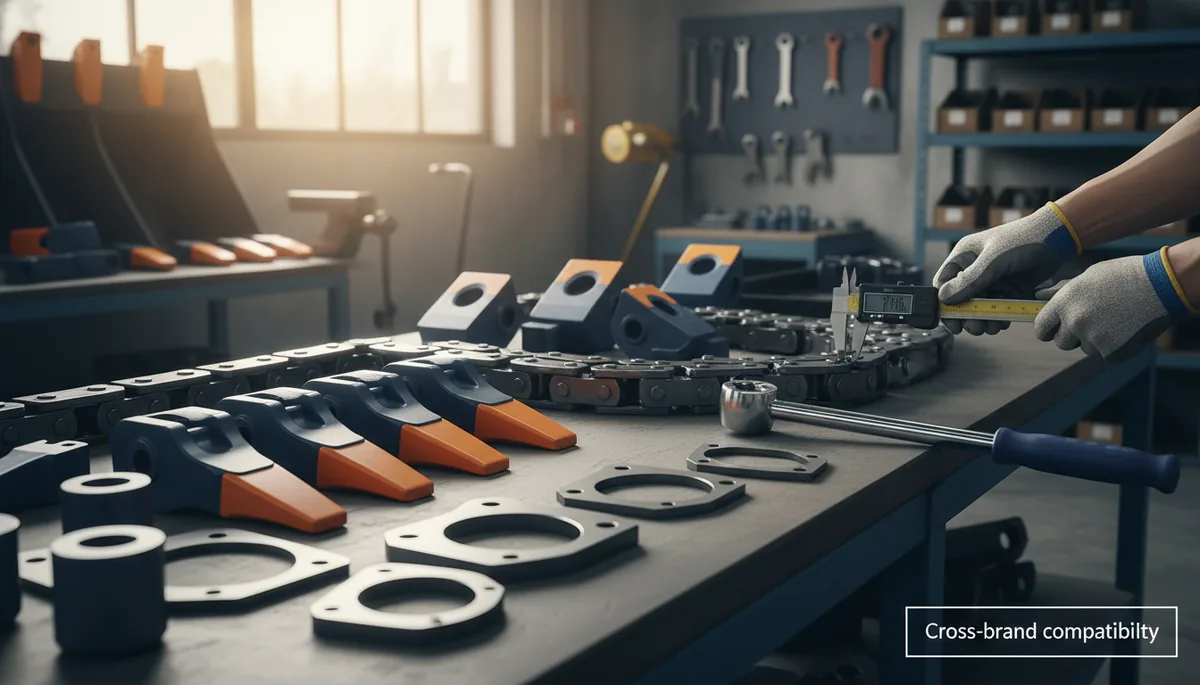
How to Match Forged Bucket Teeth with Track Chains and Bogie Guides Across Brands
This practical guide helps maintenance engineers, procurement managers, and equipment operators ensure forged bucket teeth, track chains, and bogie guides from different manufacturers fit and work reliably together. It focuses on interfaces, measurement, common mismatches, installation, testing, and smart sourcing decisions. ⏱️ 5-min read
Understand the parts and their interfaces
Start by clarifying how each part interfaces with the machine and with each other. Bucket teeth attach to adapters or a lip via a shank and locking pin; track chains link via pins and bushings and ride over rollers and sprockets; bogie guides mount to the undercarriage to position and support the chain. Key contact surfaces are pins, holes, mating faces and bearing clearances. Many suppliers follow common standards (e.g., standardized pin diameters and chain pitches), but nominal standards can still vary by brand and model, so treat drawings and physical checks as authoritative.
Identify key compatibility factors across brands
When checking cross-brand compatibility, focus on the dimensions and functional relationships that determine fit and load transfer:
- Chain pitch and roller/bushing diameter — the chain must match sprocket and roller geometry.
- Pin size and hole pattern — both for tooth retention pins and chain joint pins.
- Shank/adapter interface and tooth profile — shapes must seat fully to transfer digging loads without stress concentrations.
- Overall lengths and assembly stack-up — bogie guide length and position must align with chain pitch and carrier frame to avoid interference.
- Material and heat treatment — hardness and toughness affect wear compatibility when mixing parts from different makers.
Measure and verify dimensions before mixing parts
Create a quick measurement plan to confirm compatibility before installation. Physical verification avoids surprises during assembly.
Minimum measurement checklist
- Tooth: overall height, shank diameter/profile, mounting hole spacing, and locking-pin diameter.
- Track chain: pitch (center-to-center between pins), roller/bushing diameter, pin diameter, inner/outer plate spacing, and overall link length.
- Bogie guide: length, mounting hole locations, width relative to chain, and the clearance to carriers/rollers.
- Other: mating face flatness, wear limits, and any taper or key features on adapters/links.
Tools: vernier calipers, micrometers, pin gauges, measuring tape, feeler gauges, and manufacturer templates. Record measurements and compare them to OEM drawings or supplier spec sheets before proceeding.
Common mismatches across bucket teeth, track chains, and bogie guides
Mixing brands can introduce several predictable problems. Recognizing them early lets you plan mitigation or choose compatible alternatives.
- Differing tooth profiles or shank tapers that prevent full seating, causing uneven load and premature breakage.
- Nonstandard bolt or pin hole locations that require rework or adapter parts.
- Mismatched chain pitch or roller diameters that cause binding, accelerated wear, or poor engagement with sprockets.
- Bogie guide length or position creating interference with carrier rollers or insufficient support leading to chain derailment.
- Material hardness mismatch causing rapid wear of the softer component or fatigue of the harder one.
Strategies for cross-brand compatibility
Use a layered approach: verify documentation, use tested adapters where needed, and reduce variability where practical.
- Consult compatibility charts and cross-reference tables from suppliers — they often list drop-in equivalents and known exceptions.
- Where direct fit isn’t available, consider adapters or universal kits designed to bridge different shank or pin standards.
- When possible, standardize on a single trusted supplier for teeth, chains, and bogie guides to reduce interface surprises.
- Keep a controlled inventory of verified “cross-fit” parts and document which combinations have been tested on your fleet.
Installation best practices for cross-brand assemblies
Proper installation reduces the risk that a marginal fit becomes a failure in the field.
- Follow precise torque specs for pins, bolts, and retainer hardware; if cross-brand parts include different fasteners, use the correct grade and torque spec for each.
- Dry-fit and align components before final tightening — ensure teeth seat fully on adapters, chains sit correctly on sprockets, and bogie guides do not contact rollers when the machine is on its travel supports.
- Install in the correct sequence: generally fit the undercarriage components (chains and bogie guides) first, then install bucket teeth and secure locking devices last to allow visual verification of clearances.
- Apply recommended lubrication and anti-seize where specified; maintain grease paths and inspect seals to prevent contamination and seizure.
- Replace worn locking hardware rather than reusing deformed pins or clips from another brand.
Testing, validation, and wear tracking after assembly
Do staged validation and institute routine monitoring to catch compatibility issues before they become costly failures.
- Bench checks: rotate the chain assembly by hand to verify smooth engagement, and confirm teeth don’t rock on adapters.
- Controlled field run: operate the machine at low speed under light load for a short period to validate behavior, then inspect for looseness, abnormal wear, or interference.
- Wear tracking: record baseline clearances and wear points, then inspect at scheduled intervals for changes in pin-to-bushing clearance, tooth movement, and bogie guide contact marks.
- Document all findings and update your internal compatibility matrix — include photos and measured wear rates to inform future procurement and maintenance decisions.
Sourcing and supplier considerations for cross-brand parts
Select suppliers who can deliver consistent dimensions, traceable materials, and responsive support. These factors reduce the risk inherent in mixing parts from different makers.
- Look for suppliers with proven quality management (ISO certification), material certificates, heat-treatment data, and clear MSDS/spec sheets.
- Prefer suppliers who publish compatibility charts or supply templates and who offer adapters or universal kits for cross-fit solutions.
- Evaluate after-sales support — fast technical help, replacement guarantees, and accessible sample parts cut investigation time when issues appear.
- Consider one-stop suppliers for forged bucket teeth, track chains, and bogie guides to minimize mismatches: for example, SongWang in Fujian, China, is positioned as a single-source option for forged components and related parts, offering consolidated specs and after-sales support that help ensure cross-brand fit and consistent quality.
Matching forged bucket teeth with track chains and bogie guides across brands is a matter of careful measurement, selective sourcing, disciplined installation, and ongoing validation. When in doubt, verify dimensions, test on the bench and in controlled runs, and prefer suppliers who provide clear specs and support to close the compatibility gap.
Powered by Trafficontent